Mostbet Trading Demo Account -- Risk-Free Practice Guide

The single best advice I can give anyone considering Mostbet Trading: use the demo account first. I wish I had spent longer in demo mode before my first real-money session. The $10,000 virtual balance lets you learn the interface, test strategies, and understand the emotional rhythm of binary options without losing a single cent.
How to Access the Demo Account
Create a Mostbet Account
Register on Mostbet with your email or phone number. This takes about 2 minutes. You need an account to access demo mode -- you can't try it without registering first.
Navigate to Trading
Find the Trading or Binary Contracts section in the casino game catalog. The interface loads with the price chart and trading controls.
Switch to Demo Mode
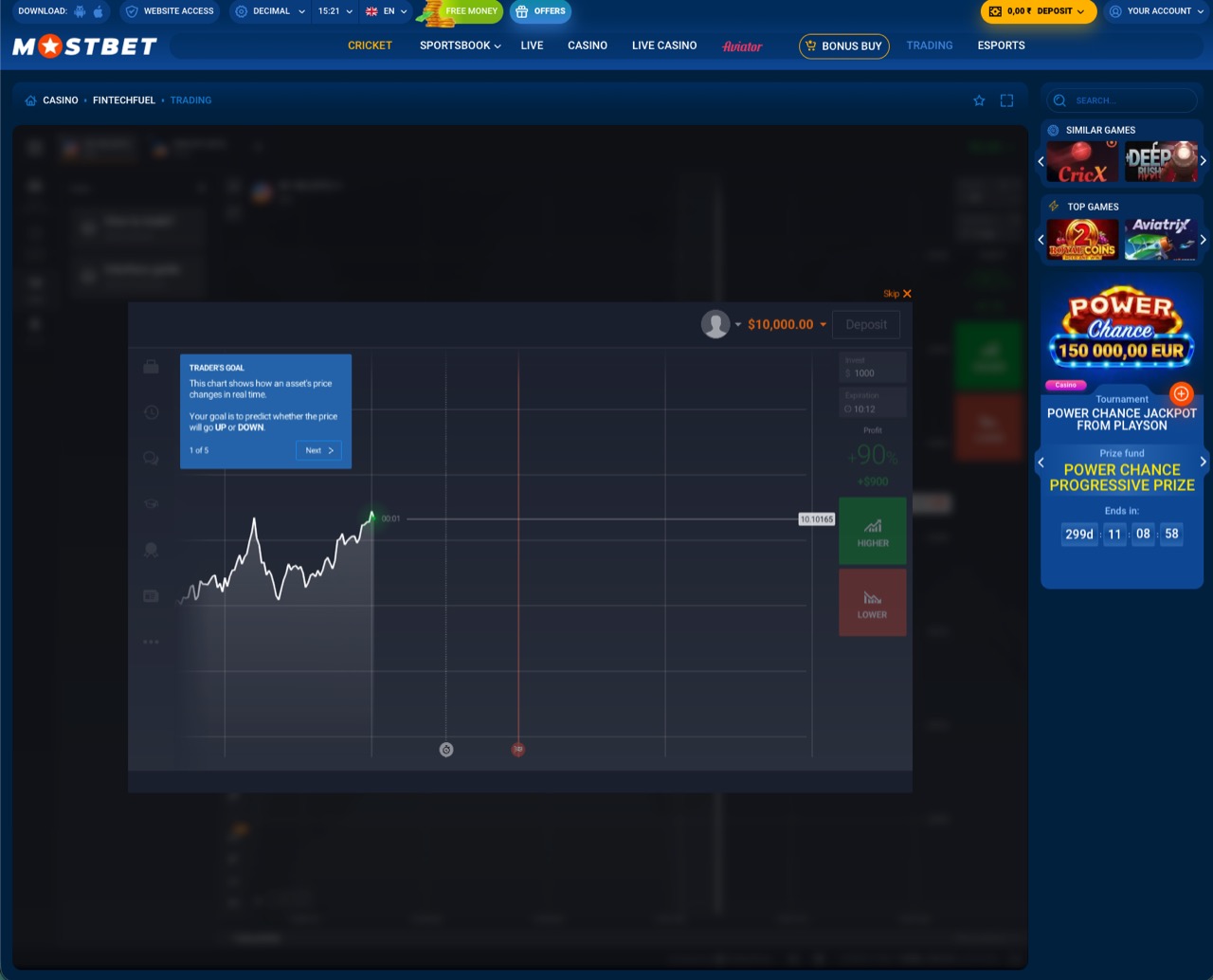
Look for the Real/Demo toggle, usually near the balance display at the top of the trading interface. Click "Demo" and your balance switches to $10,000 virtual. Everything else -- the chart, the assets, the payouts, the timeframes -- remains identical to real-money mode.
Start Practicing
Place trades exactly as you would with real money. The demo mode uses the same OTC price feeds, so the experience is identical. The only difference: your wins and losses don't affect your real balance.
Why Demo Mode Matters
I jumped into real-money trading after only 3 days of demo practice. That was a mistake. Here's what I should have used demo mode for:
Learning the Interface
The trading interface has nuances that take time to learn. Where's the timeframe selector? How do you switch assets? What happens when you accidentally click HIGHER when you meant LOWER? (It's happened to me twice. No undo button.) Demo mode is where you make these mistakes for free.
Testing Timeframes
I didn't understand the impact of timeframe selection until I'd placed about 30 demo trades. The 1-minute timeframe felt exciting in demo, and that excitement carried over to real money where it cost me actual cash. In demo, I could have learned that 1-minute trades are essentially coin flips without the financial sting.
Understanding Win Rate Reality
Most people overestimate their ability to predict price direction. Demo mode provides a reality check. After 50 demo trades, calculate your win rate. If it's hovering around 50% (which is likely), you now have data-driven proof that this is harder than it looks. That reality check is worth more than the $10,000 virtual balance.
Strategy Testing
Every strategy in my strategy guide was initially tested in demo mode before I risked real money. Trend following, support/resistance, counter-trend -- all of these started in demo. The demo results aren't perfectly predictive of real-money results (the psychological factor changes everything), but they provide a baseline.
Demo vs Real -- The Critical Differences
The interface and price feeds are identical. But two important differences exist:
1. No Emotional Pressure
Losing $50 in demo feels like nothing. Losing $50 in real money triggers stress, frustration, and the urge to chase losses. The biggest difference between demo and real trading isn't technical -- it's psychological. Demo mode cannot prepare you for the emotional impact of real financial loss. It can only teach you mechanics.
2. Risk-Taking Behavior
In demo, people tend to take bigger risks. Larger bets, more aggressive strategies, reckless entries. Because there's no consequence, you don't develop the discipline needed for real money. If you bet $500 per trade in demo but plan to bet $5 in real money, the demo experience isn't preparing you for the real experience.
My recommendation: trade demo with the same bet size you plan to use in real money. If your budget allows $5 trades, practice with $5 trades in demo -- even though you have $10,000 virtual.
Transitioning to Real Money
When should you switch from demo to real money? My checklist:
- Completed at least 50 demo trades
- Tracked results in a spreadsheet
- Know your demo win rate (ideally above 53%)
- Comfortable with the interface -- no accidental clicks
- Set a real-money budget you can afford to lose entirely
- Established session loss limits (I recommend 5 consecutive losses = stop)
- Understand that the house has a mathematical edge and you will likely lose over time
If you can check all seven boxes, you're as ready as you'll ever be. Start with the minimum bet amount. Do not jump from $5 demo trades to $50 real-money trades. Scale gradually.
My Demo Trading Results -- 50 Trades Before Going Live
I completed 52 demo trades before switching to real money. Here's a summary of what I learned:
| Metric | My Demo Results |
|---|---|
| Total trades | 52 |
| Wins | 28 (53.8%) |
| Losses | 24 (46.2%) |
| Average bet size | $50 (virtual) |
| Primary asset | US 100 OTC |
| Primary timeframe | 5 minutes |
| Net result | +$132 (virtual) |
My demo win rate of 53.8% was slightly above break-even. This gave me (false) confidence that I had an edge. When I switched to real money, my win rate dropped to 51.2% over 213 trades -- likely because the psychological pressure of real money degraded my decision-making quality.
The lesson: demo results should be treated as a baseline, not a guarantee. The mechanics transfer. The win rate does not always follow.
How to Get the Most from Demo Mode
- Trade the same bet size you'll use in real money. If your real-money budget is $5 per trade, practice with $5 virtual -- not $500. This builds realistic habits.
- Track results in a spreadsheet. Same columns as you'd use for real money: date, asset, direction, timeframe, payout, result, P/L. Start building your data habit in demo.
- Test all available assets. Place at least 5 trades on each OTC asset to understand their price behavior differences.
- Try all timeframes. Place trades at 1 min, 5 min, 15 min, and 30 min. Notice how the experience changes. Most people quickly discover that 1-minute is too fast and 30-minute requires too much patience.
- Practice your session rules. Set a demo session loss limit (e.g., 5 losses) and actually stop when you hit it. This builds the discipline you'll need with real money.
- Do not refill the demo balance. If your $10,000 virtual runs out, that's important information about your trading behavior. Don't just reset and start over -- analyze what happened.
Demo Account Limitations
- Cannot withdraw virtual funds (obviously)
- Does not simulate the withdrawal process or depositing
- The $10,000 balance is unrealistically large compared to most real-money starting bankrolls
- No emotional training for real financial risk
- Win streaks in demo may create false confidence
Demo mode is a training tool, not a predictor of future results. Use it to learn, not to validate dreams of profitability.
Start with the demo. $10,000 virtual funds. Same charts, same payouts, zero risk.
Open Mostbet Trading Demo →