How Mostbet Trading Works -- Complete Mechanics Guide

Before I placed my first real-money trade on Mostbet's Trading platform, I spent two full weeks studying every aspect of the interface, the payout calculations, and the OTC market behavior. This page is everything I learned about the mechanics, condensed into a guide that would have saved me those two weeks.
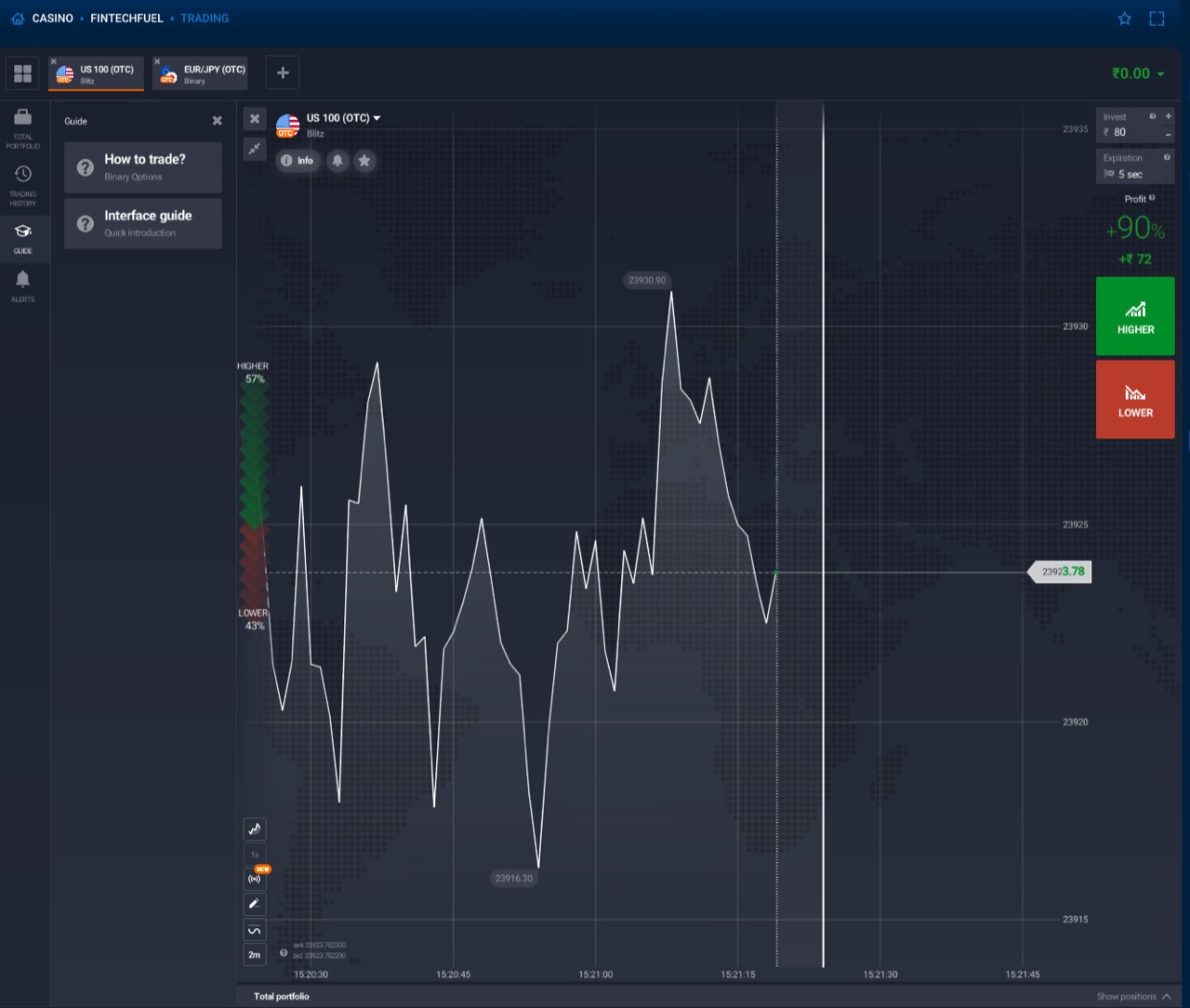
Step-by-Step Trade Placement
Placing a trade on Mostbet's binary options platform follows the same sequence every time. Here's what happens from the moment you open the Trading section:
Open the Trading Interface
Navigate to the casino section of Mostbet and find "Trading" or "Binary Contracts" in the game list. The interface loads with a price chart occupying most of the screen. Below the chart, you'll see controls for bet amount, timeframe, and the HIGHER/LOWER buttons. If it's your first visit, an onboarding popup explains the basics.
Select Your Asset
In the top-left corner, you'll see the current asset (usually defaulting to US 100 OTC). Click it to open the asset picker. You'll see options like EUR/USD OTC, GBP/JPY OTC, EUR/JPY OTC, and others. Each shows its current payout percentage. I recommend starting with US 100 OTC -- it tends to have the highest payout rate and relatively smooth price action.
Set Your Bet Amount
Enter the amount you want to risk on this trade. There are preset buttons ($1, $5, $10, etc.) and a manual input field. The interface immediately shows you the potential profit. For a $10 bet at 88% payout, it displays: "Possible profit: $8.80." That calculation is straightforward: bet x payout% = profit on a win.
Choose Your Timeframe
Select how long until the trade expires. Options typically include 1 minute, 5 minutes, 15 minutes, 30 minutes, and 1 hour. The chart adjusts to show the appropriate candlestick interval. A countdown timer appears showing exactly when the trade will expire. Shorter timeframes are faster but noisier. Longer timeframes give the price more room to move in one direction.
Make Your Prediction
This is the binary decision. Press the green HIGHER button if you believe the price will be above the current level when the timer expires. Press the red LOWER button if you believe it will be below. The moment you press, the trade is live. A horizontal line appears on the chart marking your entry price. The timer counts down.
Wait for Expiry
The chart updates in real time. You watch the price move above and below your entry line. When the timer hits zero, the final price is compared to your entry price. If the price is on the side you predicted (above for HIGHER, below for LOWER), you win. Your account is credited with your bet plus the payout percentage. If the price is on the wrong side, your bet amount is deducted.
Reading the Chart
The Mostbet Trading interface displays two chart types: a line chart and a candlestick chart. You can toggle between them in the chart settings.
Line Chart
The default view shows a continuous price line moving across the screen. It's simple and easy to read -- if the line is going up, the price is rising. Going down means falling. For beginners, this is the easiest chart to interpret. I started with the line chart for my first 50 trades.
Candlestick Chart
The candlestick view shows individual candles for each time period. Green candles mean the price closed higher than it opened during that period. Red candles mean it closed lower. The "body" of the candle shows the open-to-close range. The "wicks" (thin lines above and below) show the high and low extremes.
Candlestick charts contain more information than line charts, but remember: these are OTC simulated prices. Traditional candlestick patterns (doji, hammer, engulfing) were developed for real markets with real supply/demand dynamics. Applying them to synthetic OTC feeds is questionable at best. In my testing, candlestick pattern recognition did not improve my win rate compared to simple trend following.
Timeframe Selection -- What I Learned
After 213 trades across all available timeframes, I developed strong opinions about which ones are worth using and which are traps.
1-Minute Timeframe -- The Fast Lane to Losses
One-minute trades are seductive. You get results in 60 seconds. You can place dozens of trades per hour. The action is constant. The problem: price movement in 60 seconds on an OTC feed is essentially random noise. There's not enough time for any directional pattern to develop. My 1-minute win rate (48.3% across 58 trades) was below break-even. I stopped using 1-minute timeframes after my first month.
5-Minute Timeframe -- My Default
Five minutes gives the price enough time to develop a short-term trend. Not always, but more often than 1 minute. My win rate on 5-minute trades was 53.1% -- above the break-even threshold at 88% payout. This became my primary timeframe. It also provides a good balance between trade frequency and quality.
15-Minute and 30-Minute
These longer timeframes showed slightly more readable price action, but the trade frequency drops significantly. At 15 minutes, you can place 4 trades per hour maximum. My sample size was smaller (35 and 24 trades respectively), making the win rate data less reliable. If you have patience and prefer fewer, more considered trades, these are worth exploring.
1-Hour Timeframe
Only placed 15 trades at this timeframe. The win rate looked promising (53.3%), but the sample is too small to draw conclusions. One advantage: longer timeframes reduce the impact of random noise. The downside is the waiting -- watching a chart for an hour per trade is not everyone's idea of a good time.
OTC Markets vs Real Markets
This is the most important section on this page. Understanding what "OTC" means in the context of Mostbet Trading is essential for setting realistic expectations.
"OTC" stands for "Over the Counter." In traditional finance, OTC refers to trades that happen directly between two parties rather than on a centralized exchange. In the Mostbet context, it means something different: the prices are generated by the platform itself.
When you see "US 100 OTC" on Mostbet, you're not looking at the actual Nasdaq 100 index value. You're looking at a simulated price that loosely mimics the behavior of a stock index. It trends, it consolidates, it spikes. But it's not connected to any exchange data feed. The prices exist only within the Mostbet ecosystem. For the plain-English version, see OTC markets explained.
Why does this matter?
- You can't cross-reference Mostbet prices with real market data for analysis
- News events, economic data releases, and market fundamentals have zero effect
- Technical analysis tools designed for real markets have reduced effectiveness
- Trading is available 24/7 because there's no actual market to close
- The platform controls the price generation algorithm
I compared the US 100 OTC price on Mostbet with the actual Nasdaq 100 index during market hours. They shared zero correlation. During NYSE trading hours (when the real Nasdaq was open), the Mostbet OTC feed moved completely independently. This confirmed my suspicion: these are synthetic prices. If your bigger question is whether that makes the feature real, read is Mostbet Trading real?
Payout Calculation -- The Math Behind Every Trade
Understanding payouts is fundamental because they determine your break-even win rate.
The formula is simple:
- Win: You receive your bet back + (bet x payout%). A $10 bet at 88% payout = $10 + $8.80 = $18.80 returned.
- Loss: You lose your entire bet. $10 gone.
Notice the asymmetry. You risk $10 to gain $8.80. Winning pays less than losing costs. For this to be profitable, you need to win more often than you lose -- specifically, more than 1/(1+0.88) = 53.2% of the time at 88% payout.
| Payout | Break-Even Win % | Edge Per Trade | Expected Loss per $100 Wagered |
|---|---|---|---|
| 92% | 52.1% | 4.2% | -$4.17 |
| 90% | 52.6% | 5.3% | -$5.26 |
| 88% | 53.2% | 6.4% | -$6.38 |
| 85% | 54.1% | 8.1% | -$8.11 |
| 80% | 55.6% | 11.1% | -$11.11 |
The "Expected Loss per $100 Wagered" column is the reality check. At 88% payout, for every $100 you bet over time, you can expect to lose about $6.38 on average. This is the platform's revenue from your trading activity.
Demo Mode -- How to Practice
Mostbet provides a demo account with $10,000 in virtual currency. Accessing it is straightforward:
- Log into your Mostbet account (or create one -- you need an account even for demo)
- Navigate to the Trading section
- Look for a toggle or button that switches between "Real" and "Demo" modes
- Once in demo, your balance shows $10,000 virtual
The demo uses the same OTC price feeds and interface as real-money trading. Payouts are identical. The only difference is that no real money is at stake.
I recommend completing at least 50 demo trades before depositing real money. Track your results. Calculate your win rate. If you can't maintain above 53% in demo, you will lose money in real mode. The demo period teaches you the interface, helps you understand timeframes, and gives you a realistic preview of the emotional experience of watching trades expire.
One caveat: demo trading lacks the psychological pressure of real money. When it's virtual $5, you don't feel the loss. When it's real $5 from your bank account, the emotional weight is completely different. Demo can teach you mechanics but not money management discipline.
Full guide: Demo Account Walkthrough
Practice on the demo first. $10,000 virtual balance, same interface as real trading, zero risk.
Open Mostbet Trading →The Onboarding Flow
When you first open Mostbet Trading, the platform presents an onboarding sequence. It asks about your experience level with binary contracts and then walks you through the interface elements. The tutorial is actually well-designed -- it highlights the chart area, bet controls, timeframe selector, and HIGHER/LOWER buttons.
I appreciated that the onboarding explicitly mentions "Binary Contracts" rather than "Trading" -- it's slightly more honest about what the product actually is. The tutorial also mentions the demo mode, which is where Mostbet wants beginners to start (and I agree -- demo first, always).

What Happens After You Place a Trade
Once you hit HIGHER or LOWER, several things happen simultaneously:
- Your bet amount is deducted from your balance (held in escrow)
- A horizontal entry line appears on the chart at the current price
- A countdown timer shows the remaining time until expiry
- The chart continues to update in real time
- The area above your entry line turns green, below turns red (or vice versa depending on your prediction)
- At expiry, the chart freezes momentarily, the result appears (WIN or LOSS), and your balance updates
You cannot close a trade early. Unlike real forex where you can exit a position at any time, binary options have a fixed expiry. Once you're in, you're committed until the timer runs out. This means there's no damage control on a bad trade -- you can't cut losses at 50%. You either win full payout or lose full bet.
You can, however, place multiple trades simultaneously. I sometimes had 2-3 trades running on different assets at the same time. Each trade has its own entry price and expiry time. This allows you to diversify within a session, but it also increases your capital exposure.